One Throat to Choke, or Any Silicon You Want: Cisco at NFD40
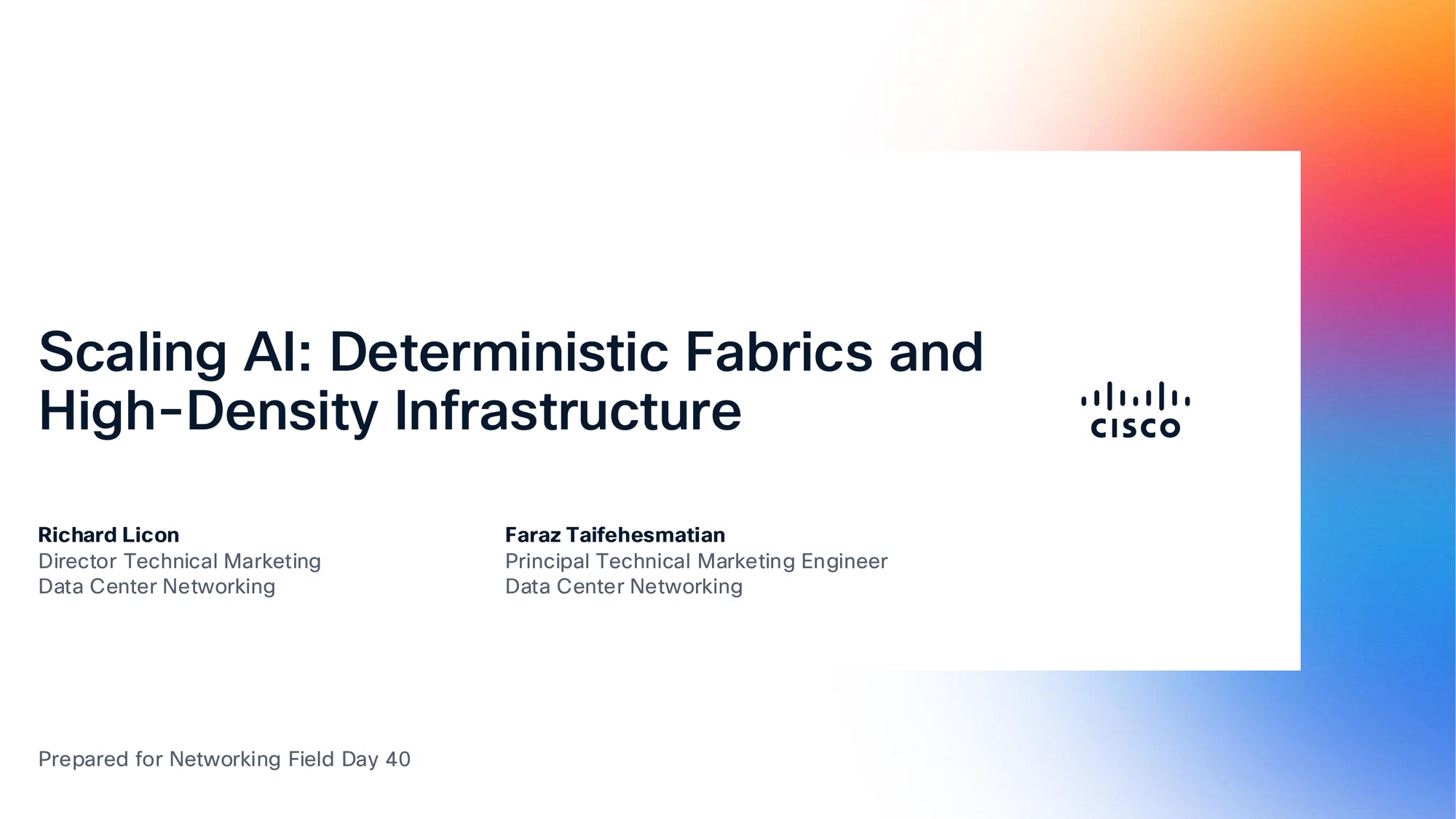
Cisco showed up to NFD40 selling two different pitches in the same session, and nobody on stage reconciled them. Richard Licon, Faraz Taifehesmatian, and Paymon Mogharabi walked through Silicon One G300, P200, the N9300 family, the N9100 family, liquid cooling on OCP ORv3 and MGX racks, and 800G LPO optics. The technical content is deep and mostly excellent. Fellow delegate Scott Robohn certainly noticed the contradiction, and he poked at it… twice.
Cisco owns the stack
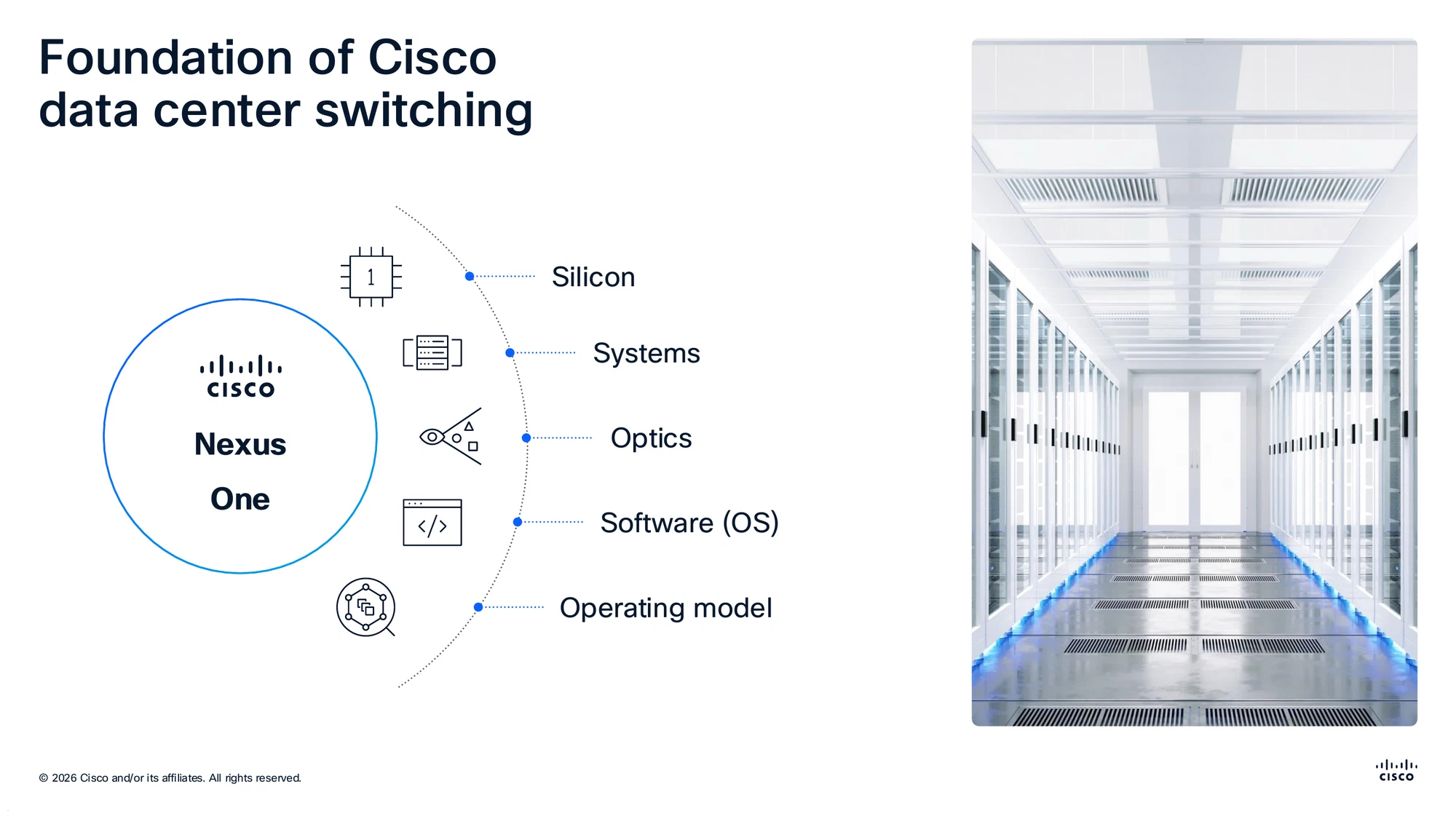
Richard opened with Nexus One, which Cisco positions as a vertically integrated foundation for data center switching: silicon, systems, optics, NX-OS, and the operating model, all designed and supported under one roof. The argument is familiar and reasonable. When something breaks at 2am on a GPU cluster, the customer wants one number to call. Demarcation lines between the switch vendor, the ASIC vendor, the optics vendor, and the NOS vendor become expensive.
Cisco backs this up with real silicon. Silicon One G200 is a 51.2T ASIC with a fully shared 256MB packet buffer across all 64 ports. G300 doubles that to 102.4T with 1.6T interfaces and adds per-packet CCG timestamping and packet trimming. P200 ships 51.2T with line-rate MACsec on every port, 144MB on-die buffer, and 16GB of HBM for deep buffering on scale-across links. All three share a P4-programmable pipeline, which Richard used to justify a specific investment-protection story. A 2024 G200 box picked up h-WCMP with dynamic load balancing mid-cycle because one hyperscaler asked for it, and a policy-based mixed-mode load balancer landed for another customer who wanted packet-spray for RDMA and flowlets for everything else. Merchant silicon customers wait for the next tapeout. Cisco customers got a software upgrade.
Faraz anchored this with a concrete before-and-after. In 2023, a 57.6T forwarding system with line-rate MACsec took a modular chassis, four line cards, fabric modules, MACsec PHYs, and 92 ASICs. In 2025, one P200 ASIC in a 3RU fixed system does 51.2T of the same work. Seventy percent less rack space, sixty-five percent less power, one chip.
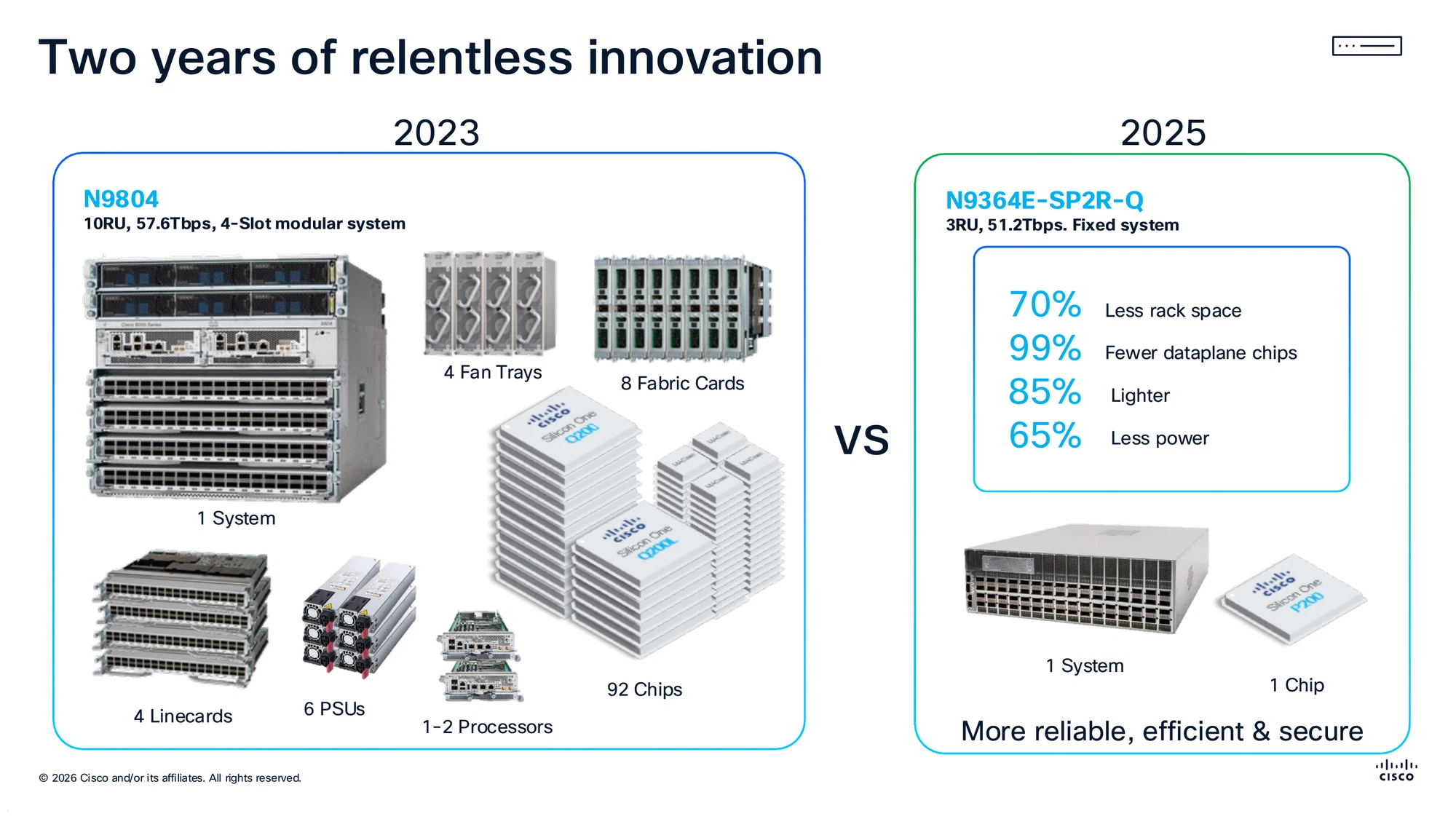
That’s the vertical-integration pitch. Cisco designs the silicon, so Cisco can build better features, smaller systems, and tighter operational loops than anyone stitching parts together.
The Second Pitch…
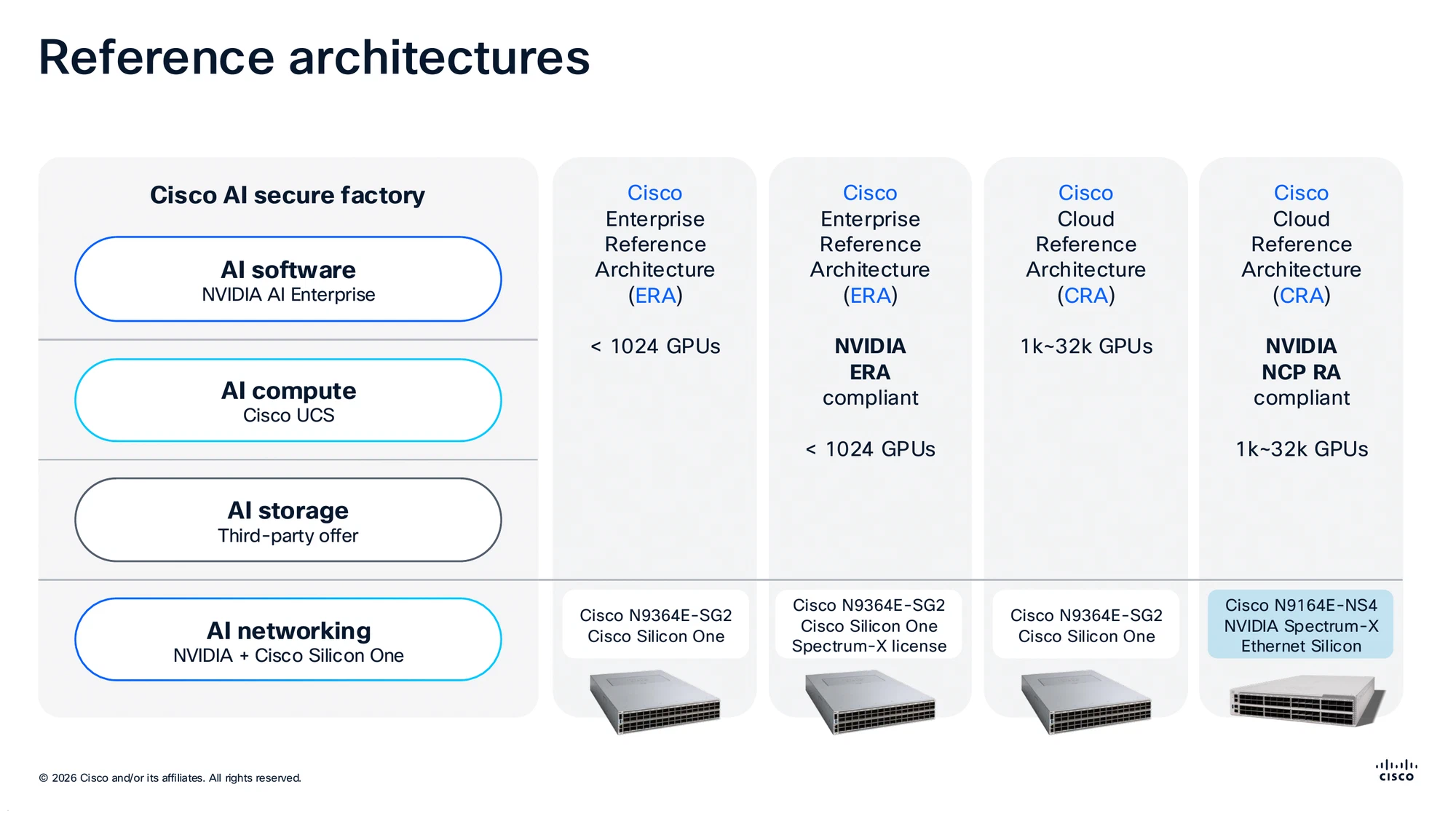
Then Richard pivoted to the reference architecture slide and the story changed. Cisco now ships four AI networking reference architectures. Three run on Silicon One. The fourth, based on NVIDIA’s NCP-RA, uses the N9164E-NS4: a Cisco chassis wrapped around NVIDIA Spectrum-X silicon with NX-OS on top.
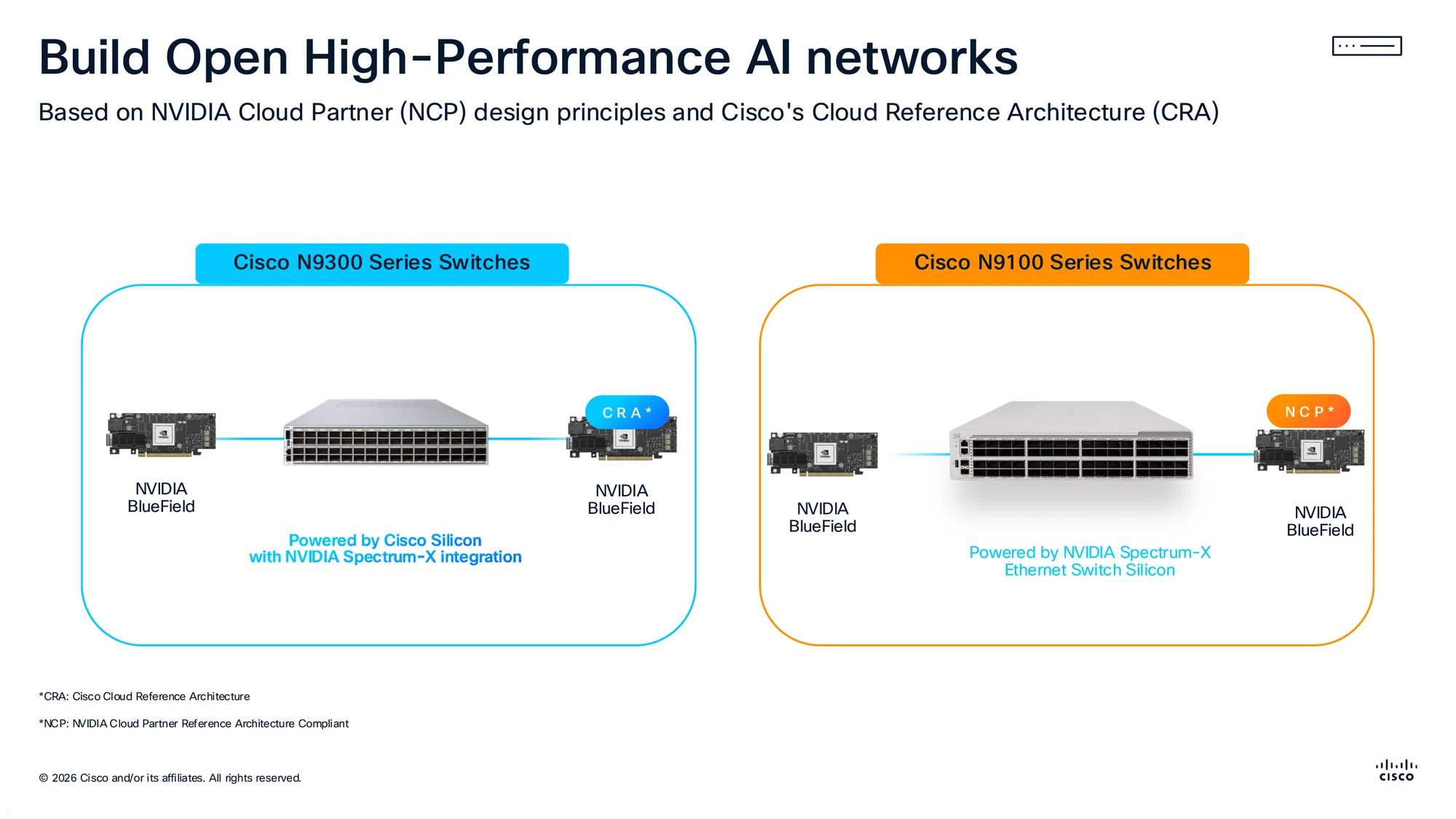
The companion slide puts the two strategies next to each other in one image. On the left, N9300 series, Cisco Silicon One with NVIDIA Spectrum-X integration. On the right, N9100 series, powered by NVIDIA Spectrum-X Ethernet Switch Silicon. Two different product lines, both in the Cisco catalog, both designed to connect BlueField NICs to GPUs, one with Cisco’s chip and one with NVIDIA’s.
Add SONiC to the picture and the menu gets longer. Cisco supports SONiC on both the N9300 and the N9100, and Richard pointed out that Cisco is the third-largest SONiC contributor after Microsoft and NVIDIA. For a hyperscaler or a neocloud that already operates SONiC across its fleet, Cisco’s pitch shifts from “we own the stack” to “we’ll fit into your stack.” That’s a different game.
Scott asked the obvious question. It’s expensive to maintain two parallel product lines that do the same job. Why do both? Faraz answered that Cisco had shipped both custom and merchant silicon before (Cloud Scale alongside Broadcom) and gave the customer-choice answer. Customer choice is the answer vendors give when they don’t want to pick a side… and Cisco doesn’t want to pick a side. That’s a reasonable product management decision. It’s also a direct concession that for a slice of the AI networking market, the vertical-integration pitch is not what the customer is picking Cisco for.
What are you actually paying Cisco for
If you buy an N9300 with Silicon One G300, you’re paying for the silicon, the systems engineering, the programmable pipeline, the shared buffer architecture, the P4 feature velocity, and the NX-OS + Nexus Dashboard operational layer on top. The Nexus One pitch maps onto the purchase.
If you buy an N9164E-NS4 with Spectrum-4, you’re paying for the chassis, the cooling, the NX-OS + Nexus Dashboard layer, and Cisco’s TAC. NVIDIA designed the ASIC, the adaptive-routing behavior, and the Spectrum-X integration with BlueField. Swap NX-OS out for SONiC, which Cisco also supports on that platform, and the remaining Cisco-specific content is the hardware integration and the support contract.
That’s not nothing. Chassis engineering, liquid cooling plates, thermal design, and TAC are real line items. It’s also not the vertical-integration story. When a customer picks that SKU, they’re buying Cisco for the wrapper, not the core.
The question for the audience is whether that wrapper is worth the premium over a competitor’s Spectrum box, and whether Cisco’s own Silicon One pitch gets louder or quieter as more N9100 SKUs hit the catalog. The next liquid-cooled Spectrum-6 box in the MGX rack is already on the slide.
The optics subplot says the same thing
The LPO presentation had a familiar pattern. The 800G LPO pitch is clean at the module level: remove the DSP from the optic, save fifty percent of the per-module power, land at under 8W versus sixteen. Total system power drops about thirty percent because fans run slower. Those numbers are real and useful.
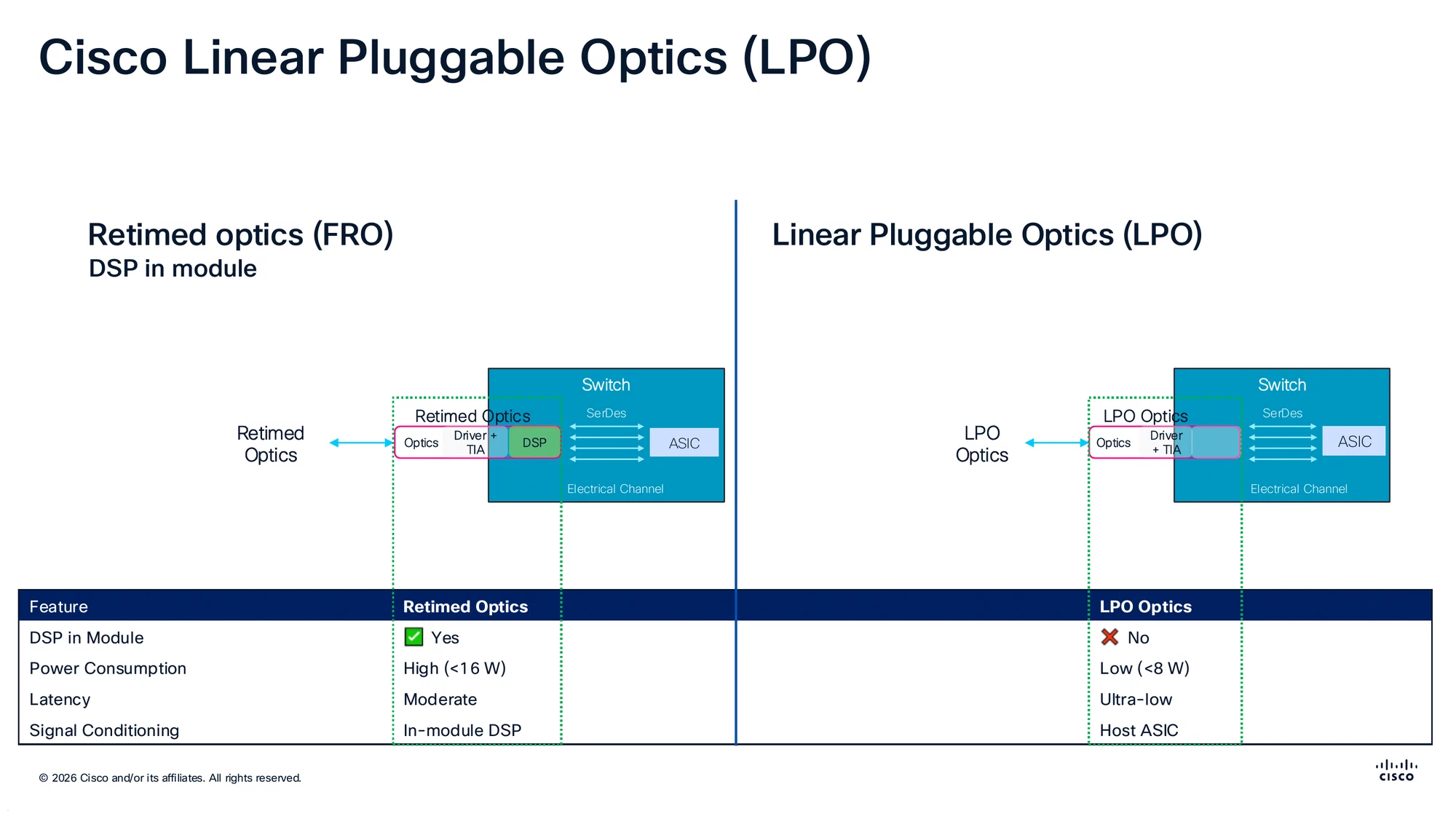
On the surface, this all makes sense. But then Scott asked the right questions… You have taken complexity out of the optic. Where did it land? How much more power and heat are you moving into the switch ASIC to carry the signal conditioning, and what does that do to total system reliability? Paymon said “that’s a question for the platform team” and pivoted. Fair answer from a Product Manager focused on optics… and exactly the answer that undercuts the vertical integration pitch. CPO is coming in the second half of 2026 per Faraz’s rough timeline, with a bigger version of the same unanswered question: how much complexity are we moving onto the switch, and what does the total system story look like once we do?
If Cisco wants to pitch vertical integration, someone on stage needs to be able to answer questions that span the stack. Nobody could today on LPO. The same question will be waiting for CPO, and it will be harder to punt on.
Question for the audience
If you’re building an AI fabric in 2026, here is the question to put to Cisco: what am I paying you for? The silicon and optics you designed, or the operational wrapper you will ship around anyone’s silicon? That answer picks between the N9300 and the N9100. Cisco didn’t choose for you on stage, and that’s the most honest thing about the session. Few vendors can credibly ship a silicon story and a merchant-silicon-plus-software story at the same time. Cisco can. The attach rates of the N9100 Spectrum SKUs and the SONiC install base on Cisco boxes over the next four quarters will settle which one operators want, and the portfolio is ready either way.
Disclosure: I attended Networking Field Day 40 as a delegate. My travel and accommodations were covered, but I was not compensated for this post and the opinions are my own. For more, please read my full Tech Field Day disclaimer.
Links & Resources
Other Delegate Posts
- NFD40 – Cisco Networking & AI - Peter Welcher, LinkedIn
- Silicon One Everywhere, SONiC On Top: A Cisco Pitch I Wasn’t Expecting - Ben Story, Pack It Forwarding
- The Cisco Silicon Advantage in the Age of AI - Tom Hollingsworth, Techstrong
- NFD40: Scale-Across, Vendor Gravity, and the Elephant out of the Room - Scott Robohn, LinkedIn
Get the rest of Networking Field Day 40 in your inbox.