
Networking
·
20 min read
Log into a Linux server that’s dual-homed to a pair of data center switches and check its bond. cat /proc/net/bonding/bond0 prints exactly one partner System ID.
Log into a Linux server that’s dual-homed to a pair of data center switches and check its bond. cat /proc/net/bonding/bond0 prints exactly one partner System ID.

Every few years comes some variation of the same ticket. A server team stands up a new backup target, we hand them four 10 gig ports in an LACP bundle, and everything comes up clean.

Four XRd containers, a full room, and a BGP table with zero prefixes in it. Taran Deshpande’s AI agent had just designed and launched an SRv6 L3VPN lab live on stage at CHI-NOG 13. ISIS came up clean.
In 2015, Matt Griswold was fresh off launching United IX here in Chicago, his own gear, an investor behind him, and he spent that era arguing a commercial, privately owned exchange was the right way …
I’ve been listening to “you should care about IPv6” talks for two decades. I’ve given a few myself… so when Nick Buraglio took the stage at CHI-NOG 13, I knew the script.
Doyle had just wrapped his automation-framework talk, and Tyler Conrad was up next. Principal engineer at Arista, Austin, fifteen years split between customer-side and vendor-side.
I went into NFD40 thinking the AI networking pitches were going to be the marketing layer dressed up in new vocabulary, and I came out convinced it’s a different design problem.
This month RFC 10005 quietly became a Proposed Standard.
Brad Gorman’s ARIN workshop laid out where routing security stands today, ROAs you can trust, ASPA shipping, BGPSec quietly retired.

I sat in Brad Gorman’s RPKI workshop at CHI-NOG 13 with the kind of attention you give a talk when somebody on stage just admitted the security model has known holes.
“We haven’t announced any products yet.

Alex Saroyan had about ninety seconds onstage before he made the architectural claim that the rest of the AI-networking conversation has been ducking.
Halfway through Tom Emmons’ scale-out segment at NFD40, a fellow delegate looked at Arista’s load-balancing slide and said what most of us were thinking… this could have any vendor’s logo on it.

Cisco showed up to NFD40 selling two different pitches in the same session, and nobody on stage reconciled them.

I’ve been building networks for nearly thirty years. I understand leaf-spine fabrics, BGP design, VRF isolation, ECMP, and congestion management.
If you’re a contractor, consultant, or anyone who VPNs into multiple client networks, you’ve experienced the pain. You connect to a Client’s VPN, and suddenly you can’t print to your local printer.

As businesses continue to shift towards remote and distributed work environments, the need for secure and reliable network infrastructure has never been greater.
Founded by Kunihiro Ishiguro and Yoshinari Yoshikawa the founders of GNU Zebra, came together to form IP Infusion back in 1999 as a commercial-grade, hardware-independent networking software company.
At times I have trouble focusing on writing articles for some of the presentations I am exposed to at Tech Field Day. Because of that, I really wanted to try something different.

BGP Communities has to be one of my favorite features added to the BGP protocol.
After much waiting from all of us, Cisco has released, on “cyber Monday” no less, VIRL.
Before we get into the how, let’s talk about the why.
I generally try to avoid oversharing when it comes to my thoughts about presentations, but I have to mention that after sitting down with Glue Networks and their “SDN” presentation, it was truly a …
Quite a while ago I had a need for some network duct tape… Policy Based Routing while useful should only IMHO be used as a temporary fix.
My feelings towards the Nexus 2000 Fabric Extender (FEX) are hardly a secret. The myriad of design choices and platform limitations present engineers with some rather difficult decisions.
In situations where service providers want to offer transparent LAN services that preserve a customers VLAN tags across your Layer-2 network, this amendment to the IEEE 802.
Recently I’ve been lucky enough to be challenged with learning a bit about Fibre Channel Switching, but I’m even luckier in that I’m getting to know it on a set of MDS switches running NX-OS …
The second day of Networking Field Day 2 started early at the Juniper EBC, luckily Abner Germanow was prepared with breakfast for the weary and slightly hung over delegates.
As many of you may know, I’m in the middle of a huge network redesign, last week our new firewalls finally arrived and it became time for us to start migrating services onto the edge network I’ve been …
I’ve never had the opportunity to really do much with F5 load balancers in the past, but recently one our system engineers needed some load balancing setup, and wanted to know if we could assign some …
Next generation data centers across the world are taking advantage of Cisco’s Virtual PortChannel.
Rather quietly, at least I never heard anything, on July 29th, Cisco released NX-OS Version 5.2(1) for the Nexus 7000 platform.
IP SLA is a function of Cisco’s IOS enabling you to analyze a Service Level Agreement (SLA) for an IP application or service.
update · 2026-10-08 This post sat here for fifteen years with some real multicast mistakes in it, mostly in the PIM-SM walkthrough where I had the wrong routers sending the wrong messages, and Fredrik …
Switch Virtual Interfaces, or SVIs on Cisco IOS use a feature called autostate to determine the interface availability.
Yesterday, work presented an interesting issue I wanted to share with everyone.

Most enterprise networks use BGP to peer with their Internet Service Providers if they want to be multi-homed.
The Nexus 1000V is a software-based Cisco NX-OS switch that integrates into VMware vSphere 4 and operates inside the VMware ESX hypervisor.
Striving to reach that last 9? Looking for a way to increase your uptime while still being able to do maintenance on your network? Wish you could shutdown your OSPF neighbors like your BGP peers?

Tired of setting up SPAN sessions? Need to do some packet analysis? Since IOS 12.4(20)T Cisco has made Embedded Packet Capture (EPC) available.
The Nexus 7000 and 5000 series have taken port-channel functionality to the next level by enabling port-channels to exist between links that are connected to different devices.
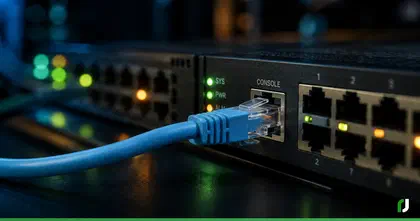
Whether your networking lab has 3 devices or 30 an access server, also commonly called a terminal server, is the vital connection between you and those devices.
In the world of first hop redundancy, we have plenty of choices. In order to make the right decision for your network you should know the basics regarding all three.
Previous thoughts on load balancing BGP were that it is not a load balancing protocol and in order to achieve any sort of balanced traffic you would have to perform some sort of route balancing.

Cisco IOS has plenty of gems contained within, but few are as fun, and as endlessly useful as the Embedded Event Manager, or EEM.
Learning the particulars of Cisco IOS is one of the most valuable things a network engineer can do. These skills will be the basis of everything you do on the lab and on your network.
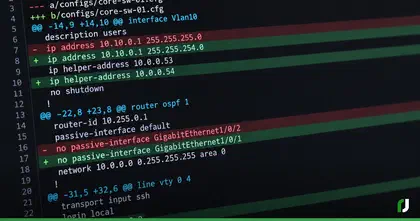
The Cisco IOS archive command is not only very useful in keeping configuration archives, but it can also be used to log commands entered into the router, along with their user name.
The concepts behind Private VLANs are in fact rather simple, but it is quite easy to get discombobulated in the details.
Bidirectional Forwarding Detection (BFD) is a UDP-based protocol that provides fast (very fast!) routing protocol independent detection of layer-3 next hop failures.
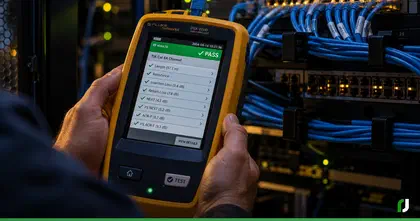
A while back, I was playing on a 3750 switch in a customers lab and came across something I’ve never seen before. It seems that some Cisco switches have a built in Time-domain reflectometer, or TDR.

Unlike subnet masks, wildcard masks allow you to use discontiguous bits which enable you to match on a range of values.
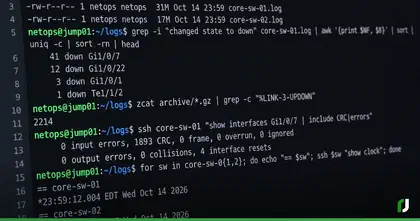
As a followup to my previous post on Regular Expression Basics, I wanted to give a few examples on using them on Cisco IOS.
At times, the ‘rules of BGP’ don’t fit the needs of our productions networks. When we get into today’s production networks how often do book configurations apply? I’ll tell you one thing.
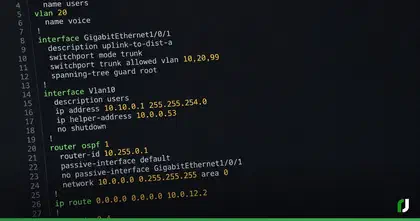
This is the fourth and final part of my Cisco voip basics series. ( Parts 1, 2 & 3 ) Our goal in this series has been setting up a working voice gateway that you could use in your home office.
Ever wanted direct network access to your Dynamips lab? Have you ever needed to lab something that used the SDM, but you run Dynamips under OSX?
Policy based routing is the process of altering a packets path based on criteria other than the destination address, commonly referred to as ‘policy routing’.
Recently a “colleague”, I use that term very loosely here, was reviewing my recommendations for changes on his network.
This is one of those tricks you wish you learned about 10 years ago, but never did. You know how easy it is to mess up a nice looking access list.

A while back I asked everyone to vote on what topic they wanted to see next, and by no surprise almost every voted for MPLS VRFs.
As a follow up to my JunOS Olive tutorial, I made a demonstration video that shows Multicast functioning via OSPF to another Olive and an ImageStream VM.
Interested in trying out JunOS? Can’t afford to build a real Juniper lab? Sounds like you need some Olives.
One of the most common questions I get concerns path selection within the router.
This is the third part of my Cisco voip basics series. ( Parts 1, 2 & 4 ) Our goal is to help you configure a Cisco voice gateway that you could use in your home office.
This is the second part of my Cisco voip basics series. ( Parts 1, 3 & 4 ) Our goal in this series is to setup a working voice gateway that you could use in your home office.
Ever thought you might be having some Layer 4 connectivity issues? Pings as you should know are ICMP transmissions and ICMP is a Layer 3 protocol (commonly used to send error messages).
This is the first part of my Cisco voip basics series. ( Parts 2, 3 & 4 ) VOIP is obviously becoming a large part of networks, even now part of your CCNP requirements are basic voip knowledge.
One of the most effective lab setups uses frame relay as its primary transport method. This is a configuration that many people use and praise for its ease of setup and maintenance.
This week I’ve started setting up a VOIP lab to explore the technology and when I’m done, I plan to integrate it into my home network.
Ever accidentally set your config register to a random value that isn’t in the Cisco documentation? No? Neither have I, but one day I encountered someone on #cisco that had.
So, I’m sure these have been posted almost on every networking blog under the sun, but who knows, right?
One of the things I used to deploy frequently at my previous position was transport for other ISPs and businesses.
Recently one of my clients asked me to help resolve an issue at an aggregation point on their network.
One of the questions I get asked several times a week by my clients is as such.
As I started building this lab, I realized that I had to find a refresher course on the IOS naming conventions.