He Was My Captain
Sir Patrick Stewart died October 28 at 86. I was seven when The Next Generation premiered, and I taped every episode I could. A lot of us had a captain before we had much else.
Sir Patrick Stewart died at home in Los Angeles on October 28, at 86, after what his family called “a brief and poignant journey with Alzheimer’s Disease and Lewy Body Dementia.” He’s survived by his wife, Sunny Ozell, and his two children.
I was working from home when I saw the news. Nothing dramatic about it. A headline on a Thursday, and then I sat there for a while not getting much of anything done.
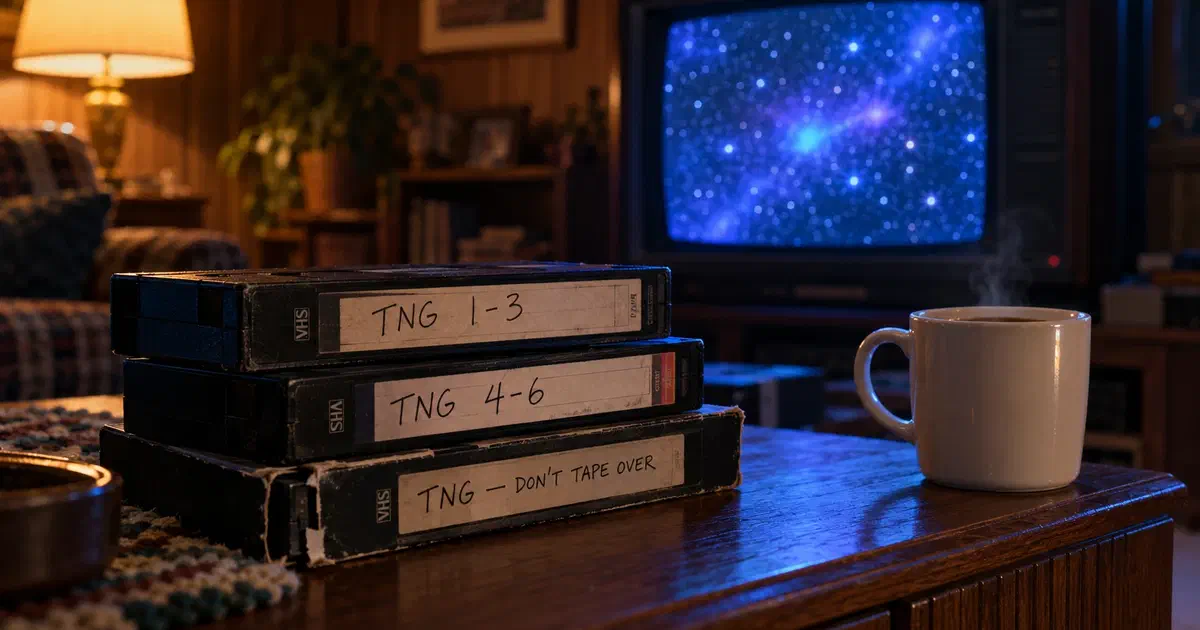
My brain went straight back to the fall of 1987. I was seven when The Next Generation premiered. It ran in syndication, so it showed up on whatever local station bought it, on whatever night they picked. I couldn’t tell you which channel anymore. I watched it when it aired, and I taped every single episode I could. Then I watched the tapes over and over again, until the good ones were worn thin. If you grew up the same way, you probably had a shelf of them too, labeled in your own handwriting.
The tapes weren’t enough, either. I still have piles of the books. The Next Generation Technical Manual, the Star Trek Encyclopedia, the TNG Companion, Phil Farrand’s Nitpicker’s Guides, Marc Okrand’s Klingon Dictionary, and a stack of others I’d have to go dig out to name. Looking back, a kid who read the technical manual for a starship that doesn’t exist, for fun, was probably always going to end up in engineering.
Then there were the conventions. My parents let me go to the Star Trek conventions in South Bend, about 45 minutes from the small town where I grew up. They’d drop me off and come back for me hours later. I met a few of the actors there, and the one I remember is John de Lancie, Q himself, the omnipotent pain in Picard’s backside. I was fifteen, and he invited me to eat my lunch with him in the little cafeteria in the basement of the convention center. He could tell I was uncomfortable, and I had no idea what to say to the guy who once put all of humanity on trial. He was very nice about it, and he told me a couple of stories while I ate. But I digress…
A lot of us had a captain before we had much else figured out.
A different kind of hero
The heroes on my TV in the eighties were Michael Knight, B.A. Baracus, Mr. Wizard, and the helicopter from Airwolf. Mr. Wizard was the only one of them I’d have trusted with a starship. Then a bald Shakespearean actor sat down in the captain’s chair. He drank tea. He read books. When something strange showed up on the viewscreen, his first move was to hail it.
Picard ran that ship by being the calmest person on the bridge. He’d ask Riker, Data, Troi, even Wesley what they thought, and he listened. Then he made the call and owned it. When he got it wrong he said so, out loud, in front of his crew. I knew he was who I wanted in charge.
Stewart was sure it wouldn’t last. He never unpacked his suitcase, expecting to be fired as soon as someone realized they’d cast a “middle-aged, bald, English Shakespearean actor” as captain of the Enterprise, and Gene Roddenberry hadn’t wanted him in the first place.
Roddenberry finally gave in on one condition, which was hair. Stewart’s audition wig had to be fetched from home in England and flown to Los Angeles on British Airways, by itself. Rick Berman remembers a Paramount executive settling it by telling them to take the Englishman and lose the wig. There’s a photo that still makes the rounds claiming to show him in it, and it’s a still from “Violations,” a fifth season episode with a flashback to a younger Picard. I’m just glad the wig never made it to the bridge. A Picard with hair would’ve been a different show.
Why it hit Gen X so hard
I’m Gen X. We were the latchkey kids, letting ourselves in after school with a key on a shoelace and the TV for company until somebody got home. The Next Generation ran from September 1987 to May 1994, which for me was seven to fourteen.
Every week the same man showed up. He kept his voice level when things went bad, and he stayed.
What I didn’t know then was that Stewart grew up with the opposite. His father was violent toward his mother, and Stewart wrote about it plainly in his memoir, Making It So. “Sometimes it was with an open hand, other times a closed fist. Always he aimed for her head.” He spent decades talking about it in public and became an ambassador for Refuge, the UK domestic violence charity. Later he learned his father had come home from the war with what a 1940 newspaper called severe shell shock, and he took up the cause of veterans’ mental health with Combat Stress too. The man who stood in as a father figure for a generation of kids grew up without a good one himself.
In a 2023 interview with PBS NewsHour, he said acting let him “drop the Patrick Stewart.” Asked what that meant, he said, “It means that I didn’t really like who I was. And I felt much more comfortable when I was somebody else.”
I read that and thought about all those tapes. Turns out he needed Picard too.
The episodes that did the shaping
The Inner Light. A probe knocks Picard out on the bridge, and he lives forty years as Kamin, an ironweaver on a planet that died a thousand years before. He gets a wife, kids, grandkids, and he learns to play the flute. Then he wakes up on the bridge, twenty-five minutes later, and all of it is gone except the flute.
The Best of Both Worlds, then Family. The Borg take Picard and turn him into Locutus, and that cliffhanger sat there all summer of 1990. When they got him back, the very next episode sent him home to France. He picks a fight with his brother Robert in the vineyard, they end up wrestling in the mud, and Picard finally breaks down and admits what the Borg did to him. My captain wasn’t fine. He had to go home and fall apart a little before he could be fine again, and I’d never seen a grown man on TV do that.
Chain of Command. A Cardassian named Gul Madred tortures Picard under four bright lights and keeps insisting there are five. Starved and stripped of everything, Picard still shouts “There are four lights!” Afterward he tells Troi he’d have said anything, and that at the end he believed he could see five. I’ve thought about that scene in more than one meeting where somebody with a bigger title than mine told me the packet capture was wrong.
The day they crashed my ship
The show ended in May 1994. That November I was fourteen, sitting by myself in my hometown’s one and only theater, a single screen, for Star Trek Generations, and they crashed the Enterprise.
That ship was the house. Seven years of the same bridge, the same ready room, the same corridors I knew better than some rooms at home. Watching the saucer section plow into that planet felt like watching somebody knock down the place you grew up in.
The same movie kills Picard’s brother Robert and his nephew René in a fire. There’s a scene where Picard sits alone with the family photo album and weeps. I’d watched him through Borg assimilation and Cardassian torture, and that was the first time I saw him completely come apart.
The movie ends with Picard and Riker picking through the wreckage of the saucer, and Picard pulls that same album out of the debris. Then he turns to Riker.
Someone once told me that time was a predator that stalked us all our lives, but I rather believe that time is a companion who goes with us on the journey, and reminds us to cherish every moment, because they’ll never come again. What we leave behind is not as important as how we lived. After all, Number One, we’re only mortal.
The call of home
He wasn’t done with us, either. Star Trek: Picard ran from 2020 to 2023, and it let us watch him get old while we were hitting our forties. Season three put the old crew back on the bridge one more time, and I’ll admit that one got me. We grew up with him, and then we got to grow old with him for a little while.
His family closed their announcement with a passage from Making It So. In it he says Jean-Luc lived a life far outside normal human experience, but stayed true to the earthbound roots that gave him his identity, and that in the end Picard feels the call of home. So did he, a working class kid from Mirfield in Yorkshire who left school at fifteen.
Mine is here in Indiana, with Jessi and Lily. I think about the kind of dad I try to be for Lily. I try to keep my voice level when things go sideways, ask what she thinks before I decide, and own it out loud when I get it wrong. I picked a lot of that up from a man on a VHS tape, long before I had words for it.
O Captain, my Captain.
New posts in your inbox when they publish. No digest, no marketing.



Comments